WSLL @ Your Service February 2026
Contents
Clunkers on Ice - Michael Keane
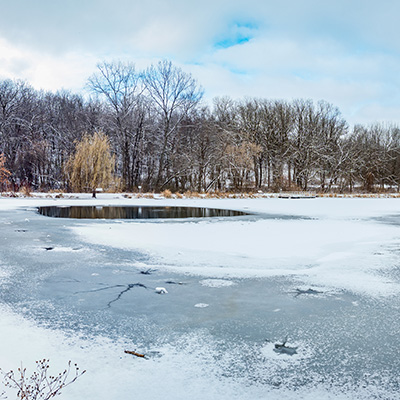
Winter brings the return of many seasonal activities to Wisconsin. Among these is the "clunkers on ice" custom, whereby local charities raise funds by selling chances on the date an old car parked on the ice will fall through. The car's plunge through the ice is not only a harbinger of spring, but result in a prize drawing among those who guessed the right date. Among the charities that have in recent years left a clunker on the ice are the Menomonie Lions Club, the Janesville Kiwanis, the Burlington Kiwanis, and Beloit Police Department's charity organization. Some communities have other ice-based guessing contests. The Village of White Lake places a mannequin called "Iron Mike" to await a spring plunge. The New London Fish and Game Club places two dummy anglers, "Pete" and "Joe" in a row boat on the Wolf River; when the boat takes Pete and Joe downstream, the contest is over.
This may raise the question of whether it is legal to leave a car on the ice to meet its spring fate. First of all, Wisconsin law prohibits the abandonment of vehicles "on or along any public highway or on any public or private property." (Section 346.94, Wisconsin Statutes). Section 342.40 similarly prohibits vehicles from being left unattended "for such time and under such circumstances as to cause the vehicle to be reasonably appear to be abandoned." The statute goes on to permit municipal governments to designate such vehicles as abandoned after 48 hours and remove them as a public nuisance.
Driving on public waterways does not seem to be illegal under state law, although it can be regulated or prohibited by county or local ordinance. The Department of Natural Resources emphasizes the need for safety and awareness with respect to any on-ice activities.
Is the law broken when the vehicle breaks the ice? There is a general statute relating to the throwing or depositing of "deleterious substances" into the waters of the state. Section 29.601, Wisconsin Statutes would certainly come into play if fuel or motor oil from the vehicle entered the water. We assume the actual working parts likely to leak liquid wastes have been removed before the vehicle is sacrificed for charitable purposes.
Perhaps most to the point is Section 287.81, Wisconsin Statutes, a broad prohibition on littering. At (2) (c), the statute states that any person who "Fails to remove within 30 days or otherwise abandons any automobile, boat or other vehicle in the waters of this state" is subject to a forfeiture not to exceed $500. A further subsection of the statute prohibits the deposit of any "large item" including vehicles, in the ice of any waters of the state, with a maximum fine of $1,000. Presumably, the charities in question can avoid penalties by complying with local ordinances and removing the clunkers from the water within 30 days.

Disability Rights Law - Noelle Brasch
This month's display features books related to disability and the law. Topics covered include the Americans with Disabilities Act, mental illness and the law, social security, employment, and more. For lawyers and lay researchers alike, use these books to get a handle on the different facets of disability rights law.
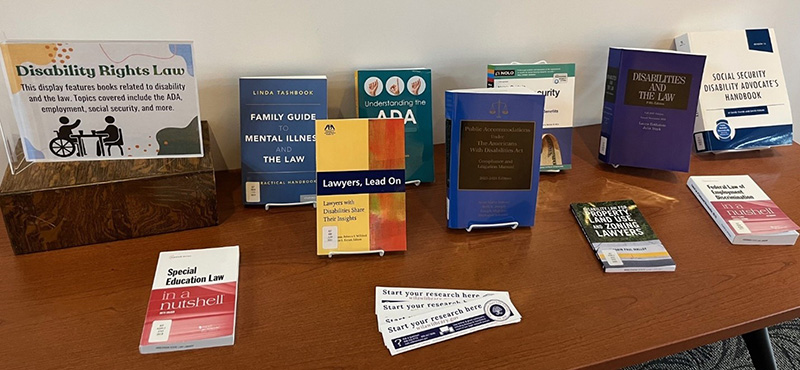
In this display
Federal law of employment discrimination in a nutshell
KF 3463 .P584 2017
Disability law for property, land use, and zoning lawyers
KF 5709.3 .H35 M35 2020
Special education law in a Nutshell
KF 4209.3 .C65 2018
Nolo's guide to social security disability : getting & keeping your benefits
KF 3649 .M67 N6 2022
Social security disability advocate's handbook
KF 3645.5 .W552 2020
Lawyers, lead on: lawyers with disabilities share their insights
KF 480 .L39 2011
Family guide to mental illness and the law : a practical handbook
KF 3828 .T37 2019
Representing people with autism spectrum disorders : a practical guide for criminal defense lawyers
KF 480.5 .A94 R47 2020
Understanding the Americans with Disabilities Act
KF 480 .G67 2013
New Books - Noelle Brasch
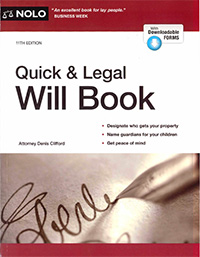
New Book! Quick & legal will book, by Denis Clifford
Call number: KF 755 .C55 2025
Containing forms and step-by-step instructions, this resource functions as a layperson's legal companion for making a will. Clifford explains basic estate planning so the reader can navigate creating a simple will on their own. This updated edition includes changes related to federal estate tax law and gift tax exclusion.
Topics include:
- Beneficiaries
- Estate planning
- Property ownership
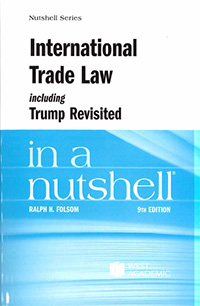
New Book! International trade law: including Trump revisited in a nutshell, by Ralph Haughwout Folsom
Call number: K 3943 .F64 2025
The ninth edition of this book continues an examination of the economics and laws governing international trade. With attention to policies of the recent administration, Folsom reviews a variety of relevant trade law topics. Pick up this easy-to-read addition to the Nutshell series for an accessible introduction to contemporary trade law.
Topics include:
- Tariff law
- Regulation of imports and exports
- Free trade agreements
- Notable presidential trade policies
See our latest New Titles list for a list of new books and other resources.
For assistance in accessing these or other resources, please contact our Reference Desk.
Tech Tip - Heidi Yelk
Opting out of Gmail's AI
Much has been written in the last few weeks regarding Gmail's new AI features. Many Gmail users are concerned about AI's ability to scan their emails, organize their inbox, suggest replies, and even "connect the dots" between separate email conversations with different individuals. AI features are turned on by default.
Here's how to turn off AI features in Gmail. On a desktop computer, sign in and go to your Gmail settings (gear symbol, upper right); Click "see all settings" to expand the settings options. You will be in the General tab menu. Now scroll down to "Smart features." Uncheck the box, reload Gmail.
The downside: turning off the AI features in Gmail will also turn off spell check, grammar check, autocorrect, smart compose, nudges, package tracking, and desktop notifications. In my testing, these tools are all tied to "smart features" and cannot be turned on separately.
Library News - Carol Hassler
In remembrance
It is with deep sorrow that we mourn the passing of one of our librarians in January. Faymarie Pluskota started as Library Associate at the Milwaukee County Law Library in 2022. She had already been a part of the Milwaukee library community for many years before joining our library. Her enthusiasm for research and dedication to service will be greatly missed.
Spring webinars
Sign up for our spring webinars! Classes are free, and qualify for CLE credit. Please reach out to Michael Keane with questions about the class and Jaden Henneman with questions about registering.
Missing or Repealed Statutes and other special problems in Wisconsin Legislative Research
Wednesday, February 18, Noon - 1:00 PM
1 CLE credit
Register for Missing or repealed statutes
This class introduces sources that can untangle unusual problems that can be quite vexing when they come up, such as finding repealed statutes, tracing non-statutory laws, and determining when and to what extent a non-codified session law has been amended.
Federal Legislative History - Some Methods in Researching Acts of Congress
Wednesday, March 18, Noon - 1:00 PM
1 CLE credit
Register for Federal legislative history
Sometimes an Act of Congress leaves some room for disagreement about how it should be applied or interpreted. This class discusses some of the documentary sources that can help give insight into what Congress was considering while passing legislation. This information, available through sources such as Congress.gov and HeinOnline as well as a variety of printed material, is the sort usually resorted to by courts and lawyers when they ask, "What did Congress really mean?"
Introduction to Wisconsin Legislative History
Wednesday, April 22, Noon - 1:00 PM
1 CLE credit
Register for Introduction to Wisconsin legislative history
I need the legislative history of a Wisconsin statute. Where do I start? What do I do? Participants will look at the primary resources used to research Wisconsin legislative history, learn about the online Wisconsin legislative drafting files, and learn some helpful tips and tricks along the way. This introductory class covers basic research strategies and sources.
Wisconsin Legislative History - Budget Bill Calamities
Wednesday, May 20, Noon - 1:00 PM
1 CLE credit
Register for Budget bill calamities
Statutory provisions created by a budget bill pose special problems in legislative history research. The budget bill process is complex and the drafting file created during the process is even more daunting. Learn how to identify statutes created by budget bills and how to navigate the drafting file. This advanced class covers additional techniques used in budget bill research.
Webinar on managing trauma
This month's Office of Lawyer Regulation lunch & learn features a focus on identifying and managing trauma, featuring Miriam Falk. Learn more below, and register for this upcoming session.
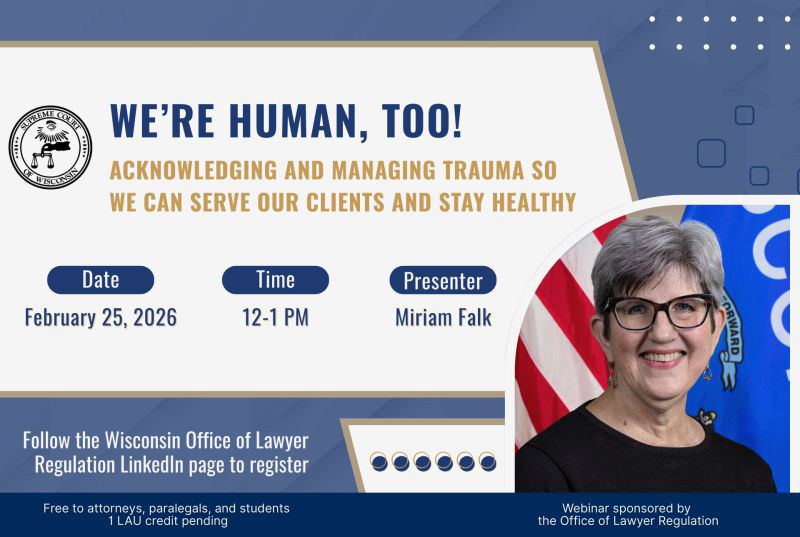
We're Human, Too! Acknowledging and Managing Trauma So We Can Serve Our Clients and Stay Healthy
Wednesday, February 25 - 12 to 1PM Central
FREE. Hosted online via Zoom.
APPROVED for 1.0 CLE/LAU.
Register for We're Human Too!
This presentation will identify what trauma is and how it impacts clients, help attendees develop tools to facilitate quality interviews of traumatized clients, define vicarious trauma and help to develop an understanding of its impact on professionals working with traumatized individuals, and provide techniques on managing the impact of vicarious trauma on both individual and organizational levels.
February Snapshot
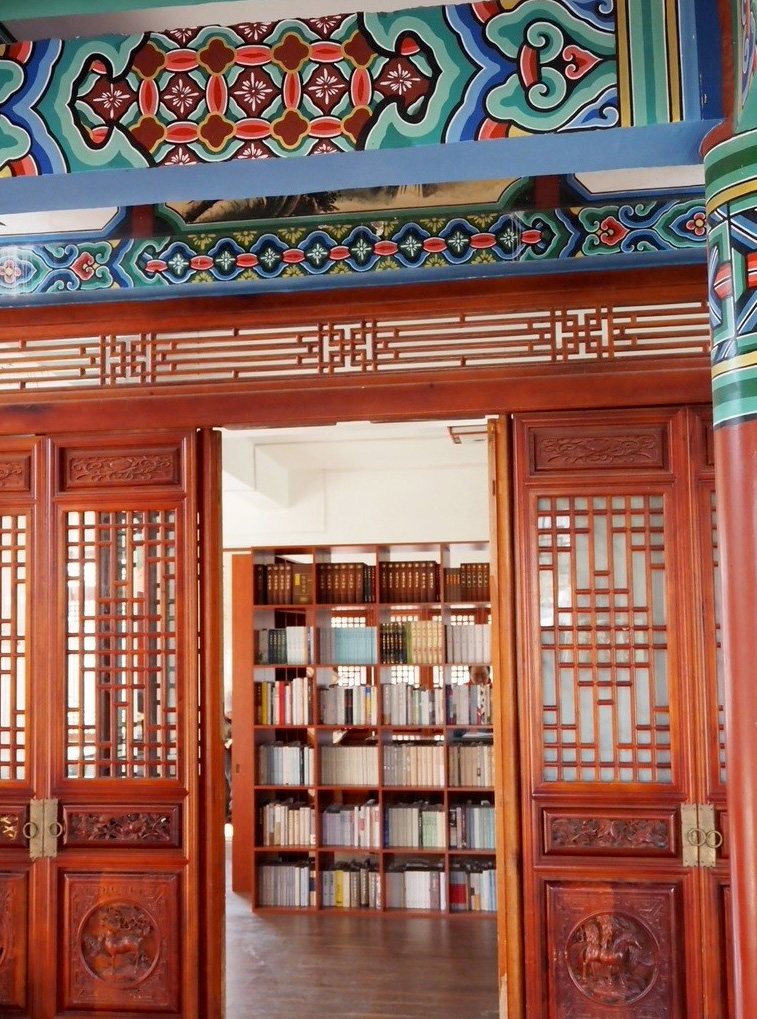
Daguan Park, Kunming, China
Photo by Carol Hassler
A public reading room featuring a mix of fiction, nonfiction, and local history collections is housed in one of the many intricately designed and painted pavilions in Daguan Park, located in Kunming, the "Spring City" of Yunnan Province in China. Within easy walking distance of downtown, this beautiful park opens onto the largest lake on the Yunnan-Guizhou Plateau. Visitors to the park enjoy boating and recreation, artful gardens, graceful bridges, and colorful pavilions. The Daguan Pavilion, the most famous in the park, was rebuilt in 1883 and features a famous couplet poem by Qing Dynasty scholar Sun Ranweng, describing the beauty of the surroundings and the history of the Yunnan region.
We are accepting snapshots! Do you have a photo highlighting libraries, attractions or points of historical interest? Send your photo to the editor at carol.hassler@wicourts.gov to be included in a future issue.

